

An adjective is a word that describes, qualifies, modifies, or tells us more about a noun or pronoun. However, sometimes we may want to compare distinct features of two or more nouns and that’s why today we are going to learn about comparing adjectives.
Lesson Objectives
At the end of this lesson, you should be able to:
- Understand the degrees of comparison for regular and irregular adjectives.
- Explain the rules for writing some comparative and superlative adjectives.
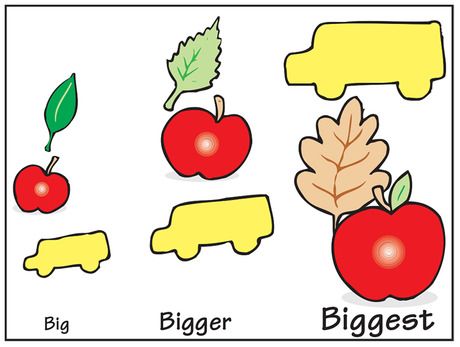
There are three degrees of comparison:
1. Positive
This is used when the adjective is describing only a noun.
Examples:
- This is a tall man.
- He has a long pencil.
2. Comparative
This is used to compare two things or persons and -er is added to the end of the word.
Example:
- This man is taller than that one.
3. Superlative
This compares more than two nouns and -est is added to the positive in most cases.
Examples:
- John is the tallest man of all.
- Sheila has the longest pen.
Note:
1. Only one or two-syllable adjectives form their comparative and superlative by adding -er and -est respectively.
2. Most adjectives of two or more syllables use more and most with their comparative and superlative respectively.
Examples:
| Positive | Comparative | Superlative |
| Beautiful | More beautiful | Most beautiful |
| Honest | More honest | Most honest |
3. Other adjectives ending in -y, or -ly usually take the -er and -iest forms.
Example:
| Positive | Comparative | Superlative |
| Easy | Easier | Easiest |
4. For irregular adjectives, their comparative and superlative forms do not take -er and -est.
Examples:
| Positive | Comparative | Superlative |
| Much | More | Most |
| Little | Less | Least |
Lesson Recap
Remember, there are three degrees of comparison:
- Positive
- Comparative
- Superlative
1. Positive adjective: It’s used to describe a single noun.
2. Comparative adjectives: Compare one person or thing with another and enable us to say whether a person or thing has more or less of a particular quality.
3. Superlative adjectives: Describe one person or thing as having more of a quality than all other people or things in a group.
We also looked at the regular adjectives, which form their comparative and superlative by adding -er and -est.
While irregular adjectives form theirs in an unusual way by changing the whole word.
Also, regular adjectives with two or three syllables use “more” and “most” before the positive to form their comparative and superlative forms respectively.
Watch the full recap of this lesson in the video below.
If you enjoyed this lesson, you can sign up on Gradely to experience more.
Share Post:

Eniola Makinde
Get our latest articles in your inbox. Sign up for email alerts.