

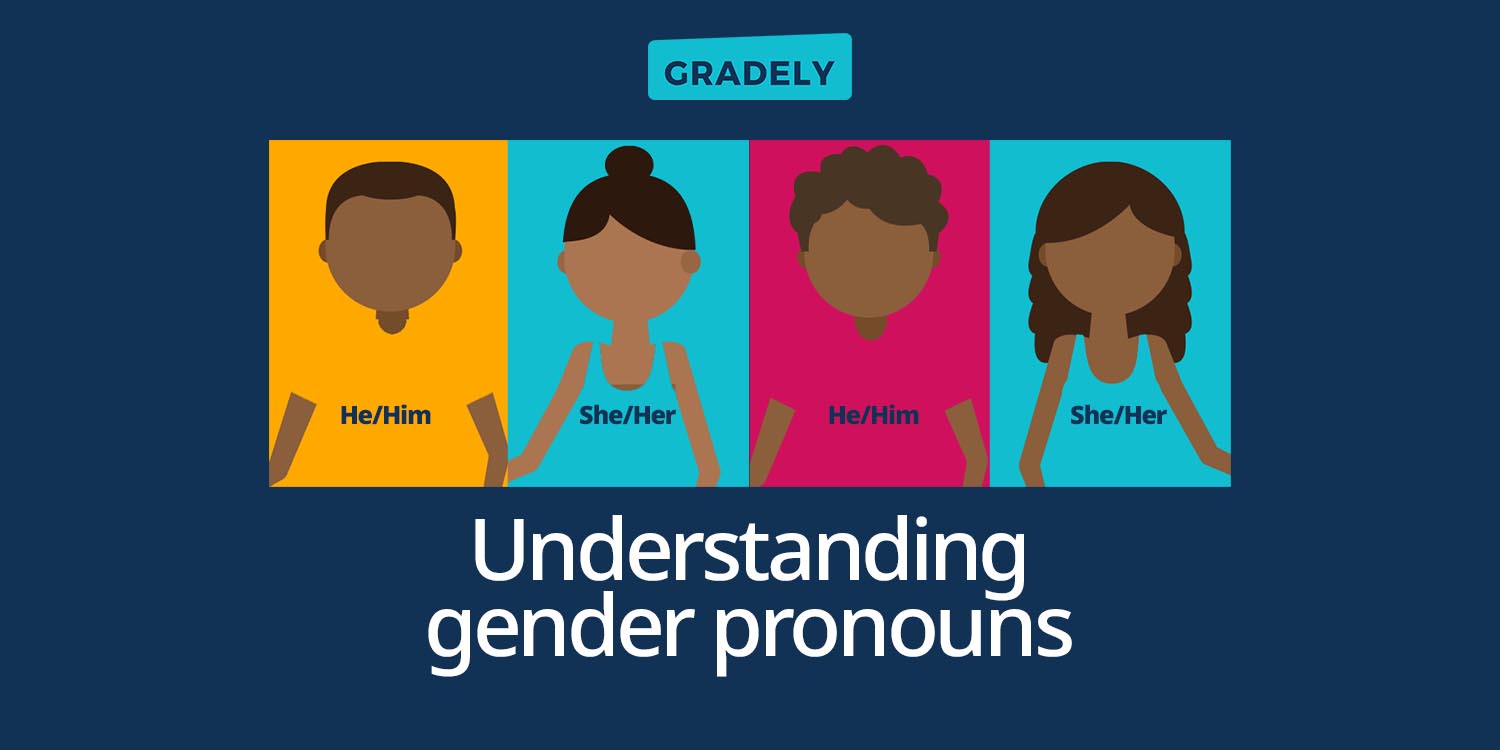
In today’s world, many social media platforms give you the option to share your pronouns. This helps people know how to refer to you without any confusion. But have you ever met someone whose name didn’t match what you thought their gender was?
That happened to me recently. I met a new friend who turned out to be male, even though his name was more commonly associated with females. It made me think about how important pronouns are in our daily interactions.
Names don’t always tell you someone’s gender. For example, names like Favour, Blessing, Ayo, or Biodun are used by all genders. But when you hear someone referred to as “she” or “her,” you immediately know they identify as female, even if you’ve never seen them. Pronouns are important because they reflect who we are and how we express our gender.
What Are Gender Pronouns?
Gender pronouns are words like he/him, she/her, or they/them that people use to express their gender identity. Using the correct pronouns is more than just a language rule—it’s a sign of respect. When we use the right pronouns, we show respect and recognize someone’s identity.
Here are some examples of common pronouns:
- He/him – used for boys or men.
- She/her – used for girls or women.
- They/them – can be used when you’re talking about more than one person, or sometimes for just one person.
Subject and Object Pronouns: A Quick Grammar Lesson
When using gender pronouns, it’s also essential to understand how they function within a sentence. Pronouns can be either subject or object pronouns, depending on their role. Here’s a simple breakdown:
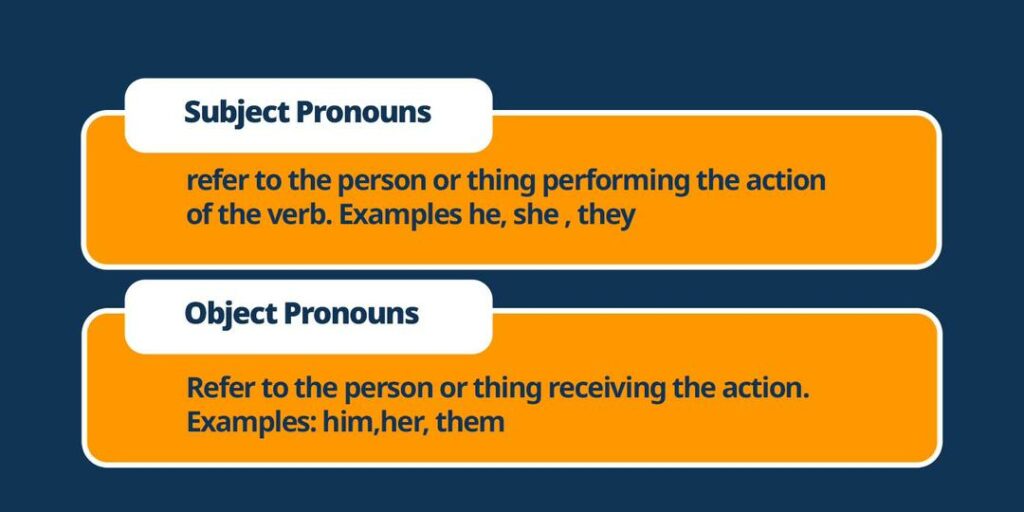
- Subject pronouns refer to the person or thing performing the action of the verb. Examples: he, she, they.
- Object pronouns refer to the person or thing receiving the action. Examples: him, her, them.
Sometimes, people mix up subject and object pronouns, which can lead to incorrect sentences. For example:
Incorrect: “I saw he and his daughter at the cinema.”
Correct: “I saw him and his daughter at the cinema.”
In this example, ‘I’ is the subject (the doer of the action), while ‘him and his daughter’ are the objects (the receivers of the action). Since ‘him’ is the correct object form of ‘he’, it should be used in this context.
Another example is “They invited she and her family to their house.” Can you identify the subject and object in this sentence? Correct! The subject is ‘They,’ and the object is ‘she and her family.’
However, there’s an issue with the object because ‘she’ is a subject pronoun, not an object pronoun. The object form of ‘she’ is ‘her,’ so the sentence should be: “They invited her and her family to their house.”
A similar mistake can be seen in “I will give the assignment to they and their friends,” which should instead be “I will give the assignment to them and their friends” since ‘them’ is the object form of ‘they’.
Understanding these simple grammar rules can help you use pronouns correctly, ensuring clear communication and respect for people’s gender.
Why Pronouns Matter
Pronouns help people feel accepted. When you use the correct pronouns, it shows you respect their gender identity. Getting someone’s pronouns wrong can make them feel excluded, even if it’s an accident. By using the correct pronouns, we create spaces where everyone feels valued.
Pronouns also make conversations easier. Imagine having to repeat someone’s name every time you talk about them. Instead of saying, “Sarah went to Sarah’s house and Sarah brought Sarah’s book to read,” you can simply say, “She went to her house and brought her book to read.” Pronouns simplify sentences and help people understand who you’re talking about quickly. Without pronouns, our language would feel repetitive and confusing.
Using pronouns correctly helps keep our conversations clear. If you use the wrong pronouns for someone, the listener might get confused about who you’re talking about. For instance, if you say, “He is a great cook,” but you meant to refer to someone who is a female, the listener might picture the wrong person. Correct pronouns keep things straightforward and make communication more effective
Best Practices for Using Pronouns
To ensure you’re using pronouns correctly and inclusively, here are a few best practices:
- Always ask for gender when you’re unsure. It’s better to ask than to assume.
- Learn the correct way to use pronouns, both subject and object.
- If you make a mistake, apologize and correct yourself. It shows that you care about
- Practice, the more you use pronouns correctly, the easier it will become. Over time, using the right pronouns will feel natural, and you’ll be more comfortable in your conversations.
To learn more about pronouns and explore other subjects you’re finding challenging, get started now. Let’s make learning easy and exciting, one lesson at a time
Share Post:

Ifeoma Iwelunmor
Get our latest articles in your inbox. Sign up for email alerts.



This was very helpful thank you
I understood everything perfectly
This was very very helpful. Thank you